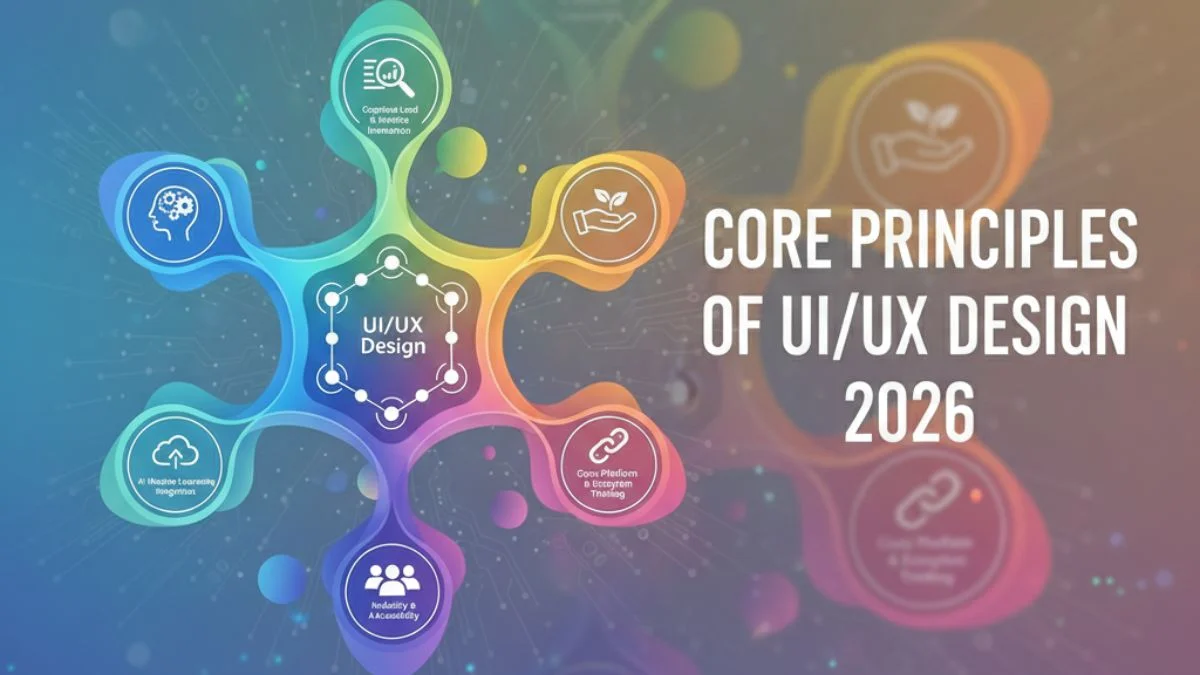
By 2026, UI/UX design will have evolved beyond merely making digital products visually appealing. It is now a strategic business tool that has a direct impact on customer trust, engagement, retention, and ultimately, revenue. With the rapid advancement of technology, the users' expectations have also heightened. They want digital experiences to be not only fast but also intuitive, personalized, accessible, and emotionally engaging. If an interface is not well-designed, users can be gone in a matter of seconds; a great user experience, on the other hand, can transform one-time visitors into repeat customers.
Today, companies face competition not just in terms of features and pricing but also in the arena of customer experience. Whether it is a website, mobile app, SaaS platform, or enterprise software, UI/UX design frequently serves as the hurdle or the winning edge. Innovation in AI, a surge in mobile usage, accessibility norms, privacy issues, and a rising interest in human-focused design have all influenced the fundamental UI/UX design principles in 2026. A grasp of these principles and their implementation is of utmost importance for entities that want to develop digital products with which customers emotionally connect.
Essentially, user-centered design is the foundation of UI/UX design in 2026. The concept is mostly about developing the product for actual users and basing it on their behaviors, needs, and pain points rather than following internal biases or making wild guesses. Deep user research, such as interviews, usability tests, behavioral analysis, and user feedback, goes a long way in helping firms create hit digital products.
Simply segmenting the consumer market into age or income brackets is no longer enough for designers; they need to delve into the user's intent and the context. We are aware that users can be doing half a dozen other things while at the same time interacting with one product; they can be rushed or use different devices throughout the day. Going for a user-centered design will guarantee that the interface is still simple and intuitive, whatever the conditions are. Businesses that embed user-centered design in their DNA from ideation have an edge over those that are beauty or functionality-obsessed only.
One of the key UI/UX tenets that has not changed is simplicity; however, in 2026, it is no longer about feature reduction. Being able to simplify is merely a matter of presenting complexity in a way that the user finds absolutely natural. When products keep getting better and more feature-rich, the challenge is how to maintain a clean look and flow for the users.
Users today are only interested in the end functionality of the interface, and they do not want to have to figure out how it works. Therefore, you need to have a logical structure, non-ambiguous and expressive labeling, intuitive navigation, and do away with unnecessary elements or distractions in a manner that your product will seem to be working naturally. If the interface is kept simple, users feel empowered, and this by itself is a big relief, leading to enhanced user satisfaction and usability.
Employing uniformity in UI/UX design is an excellent way of ingraining familiarity and trust. As we near 2026, brands are becoming accessible via different channels such as websites, mobile applications, dashboards, and wearables, with voice interfaces also gaining popularity. It is a matter of survival to have a seamless experience, for which you must ensure that your design patterns, colors, typography, and behaviors of interaction are uniform not only in different platforms but also in branding and messaging.
Humans have a limited attention span, so instead of having to relearn interfaces every time, users can use the energy for discovering new features or being more productive. The use of design and component libraries has been so embraced that these are now viewed as standard operating procedures, which in turn help keep the design and development teams on the same page as the product scales. Companies that go the extra mile to make their interface consistent will be rewarded with a strong brand, dependable customer experience, and eventually, customer loyalty.
Accessibility cannot be an option anymore in modern UI/UX design. By 2026, inclusive design will be a fundamental requirement not only legally and morally but also in terms of business. Accessible design makes sure that digital products are usable by people with different types of disabilities, such as those who are visually, hearing, physically, or mentally impaired.
Accessibility design features are actually beneficial to all users. For instance, a well-thought-out color contrast, easy-to-read font, the ability to use a keyboard for navigation, and screen reader compatibility can really improve the overall experience. Besides, companies that choose to make their products accessible can be seen as socially responsible, which may ultimately lead to a wider audience. Actually, accessible products sometimes get higher rankings on search engines and do better on different devices.
Since mobile usage continues to be the leading mode of access, first designing for mobile remains a basic principle in 2026. Still, it has, in fact, become context-aware design. It is not enough that the designers think just about screen size, but they must also think about how, when, and why people are using mobile devices.
Users, for example, can be running errands, or in a dark place, or coming from an area with a weak network to use the applications. Hence, the interfaces should not only be responsive but also very fast and optimized for touch interactions. Furthermore, context-aware design involves changing the content and features depending on the user’s location, device type, and behavior. A product that amazingly adapts and gets smarter is the one that wins the love of people the most.
Performance has become central to user experience in 2026. Customers want things done at once, pages loaded rapidly, and smooth interactions. Even slight delays may frustrate users so much that they give up. UI/UX designers should team up with developers so that visual design doesn’t suffer performance.
Animations that are fine-tuned, assets that are lightweight, and layouts that are simple but effective are of the essence to users. Perceived performance matters as much as real performance. When users are guided through loading screens, skeleton screens, and transitions in style, they tend to feel that the system is responsive, even if in reality some processes require time. Thus, speed has ceased to be merely a technical issue; now it is a major UX aspect.
Emotional design has become a signature of UI/UX in 2026. Products that look human, empathetic, and full of emotional intelligence tend to have a deeper connection with users. Besides microinteractions, nice wording, small animations, and suitable feedback also matter for emotional involvement.
Production teams focus on the experience of the users emotionally, beyond merely their activities. A timely animation, a positive message, or a personalized greeting can go a long way to enhance users’' contentment. Emotional design is not only an excellent mechanism for trust and loyalty building, but it is also a way of making users feel that they have been heard and appreciated.
Personalization journeys became far more complex when AI-enabled smart personalization exploded on the scene. The UI/UX design of 2026 uses data to provide users with content, features, and interfaces that suit their needs, style, and preferences at an individual level. As a result of personalization, usability gets better since people are not bombarded with stuff they don’t care about, and what is of greatest interest to them is highlighted.
Yet, personalization should not compromise transparency and privacy. While users would like experiences tailored to their needs, at the same time, they want to have control over their data. Good and ethical personalization that respects the wishes of the users is a way of gaining their trust. If properly implemented, personalized UX would be a great tool for increasing engagement, conversion, and loyalty.
Visual hierarchy continues to be the backbone of great UI design. By 2026, the average user will be exposed to an enormous amount of information every day, hence making clarity an absolute necessity. A well-established visual hierarchy serves as a sort of a map that leads the users from one point of the content to another without any friction, helping them know which part is more important and which action they should take.
Legibility at a glance is achieved through various elements such as font, line spacing, contrast, and arrangement of elements on the page. It is the obligation of the designer to make sure that the typeface used is easy to read on the screen of any device and that the crucial pieces of information are highlighted without the users being overloaded visually. A well-defined visual hierarchy not only helps to better understand but also lessens the chances of mistakes while increasing the ease of use in general.
Due to increasing concerns over data privacy and security, trust has become one of the crucial components of any digital interaction. Therefore, the UI/UX design of the year 2026 is going to be an extremely important player in the field of trust communication through the use of clear messages, open processes, and safe engagements.
Users must be able to consistently comprehend the management of their personal data, the reasons behind the requests for permissions, and the consequences of their actions. Friendly confirmation messages, well-worded error explanations, and privacy-related justifications not only alleviate the user's tension but, at the same time, restore trust. An honest design signals that users are free to go deeper in their relationship with digital products.
The days when one could design UI/UX just once and assume it lasts forever with no additional work are simply gone. It has been recognized that the habits of users change, technology gets replaced, and business priorities evolve. It is therefore highly necessary for designers to regularly run usability tests, conduct analytic reviews, and collect user feedback so as not only to know the parts of the products that cause friction but also the parts that give users delight.
Through continuous iterations, products are able to keep up with trends, serve users effectively at any given moment, and grow advantageously when time passes. The organizations that have a culture of embracing continuous changes will always stay at the forefront of user experience developments and market shifts. UI/UX design nowadays is considered to be a never-ending dialogue between the users and the product team.
The main tenets of UI/UX design in 2026 encapsulate the transformation of digital experiences into more human, intelligent, and universal. User-centric design, minimalism, uniformity, accessibility, performance, emotional bonding, customization, and trust have become the pillars of successful design tactics. As technological progress continues, the function and significance of UI/UX designers are on the rise.
Being guided by the strong principles of UI/UX, companies are not only designing better interfaces but also creating long-lasting connections with their users. In the highly competitive digital world, a superb user experience is not a privilege but a requirement. Through the adoption of these principles, the organizations get the possibility to build products that are not only practical but also deeply impactful, unforgettable, and ready for the future.
The core principles of UI/UX design in 2026 entail user-centered design, simplicity, consistency, accessibility, mobile-first experiences, performance optimization, emotional design, personalization, visual clarity, and trust-focused interfaces.
UI/UX design matters because it has a direct effect on user satisfaction, conversion rates, customer retention, and brand trust. Through a great experience, companies can maintain their competitiveness in a digital-first world.
User-centered design makes UI/UX better by paying attention to the real needs, behaviors, and pain points of users. It guarantees that products are simple to use, efficient, and meet user expectations rather than being based on guesswork.
Accessibility makes sure that digital products can be used by everyone, including people with disabilities. By making the UI/UX accessible in 2026, you not only make it user-friendly but also comply with the law, improve your SEO, and increase your potential market.
Mobile-first design is centered around the idea of making the experience on smaller screens as good as possible by giving users what they need faster and more intuitively. When you do that, you end up with an overall better experience on any device.
Performance is one of the UX principles in the sense that users get irritated and consequently frustrated if it takes time before pages are done loading and interactions lag. Therefore, if the interface is quick and responsive, it will help increase user engagement and will also reduce site visit abandonment.
Emotional design takes into consideration the user’s feelings while they are using the product. It incorporates the use of small pleasant elements like animations and changes in the tone of communication and feedback to establish positive emotional connections and loyalty of users.
AI is transforming UI/UX design with features such as personalization, behavior prediction, intelligent suggestions, and interfaces that change according to the user, thus making the digital experiences more meaningful and efficient for users.
UI design handles the visual components and the arrangement of an interface, whereas UX design is about the overall user journey, usability, and the experience one gets while interacting with the product.
Great UI/UX will make what the user is trying to do easier, clearer, and more trustworthy, and thus will lead them gently to the desired action. This would result in more people interacting with the site, getting converted, and lastly becoming loyal customers.