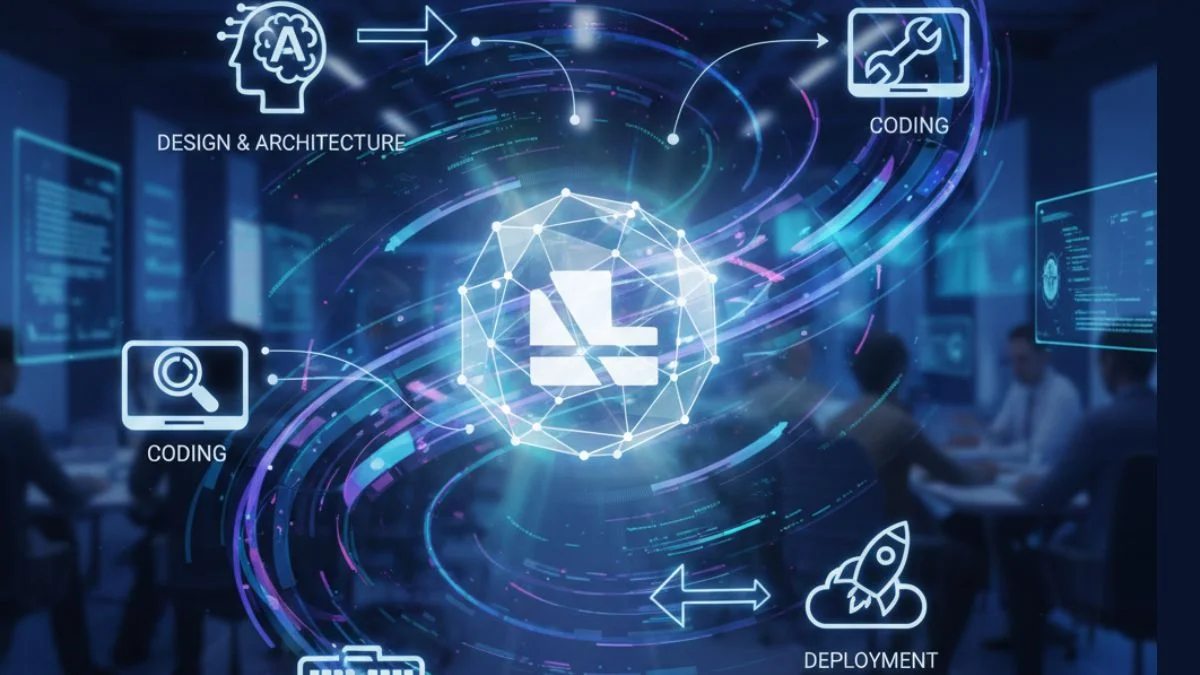
The software industry has undergone a variety of significant changes, ranging from cloud computing to mobile-first applications. As of 2026, Large Language Models (LLMs) are the tools that have the most influence on software development workflows. LLMS don't need to be only coding assistants—they are now considered to be vital members of the development teams that use them; thus, the teams employ LLMs for writing, testing, deploying, and maintaining code in an optimized manner.
At RZ Technologies, we have experienced the impact that LLMs have had on software projects, which has been a major factor in the overall success of businesses through achieving increased productivity, higher quality, and quicker time-to-market. This post is about how LLMs transform software workflows and is dated 2026.
In today's software development processes, LLMs serve as intelligent team members who can even interact with developers live. They are capable of writing, checking, and streamlining the code while also producing suggestions for the structure and the security of the program. LLMs lessen the mental effort that developers have to endure; thus, the developers can engage in higher-level problem-solving. LLMs provide instantaneous solutions for coding chores, debugging, and even writing up the necessary documents, and hence, they have reached the status of a can-not-do-without partner unit in software development.
By the year 2026, LLMs will be the primary source of code for many projects. They are not simply code snippets or templates that can be traditionally used; rather, LLMs learn the project structure, standards of coding, patterns of design, and business logic. A developer may, for instance, instruct an LLM to produce a controller for a real estate system, and in seconds, the LLM will return the code that is neat, efficient, and ready for the production environment. Consequently, this capacity elevates the speed of the development, eliminates the redundancy of the coding, and at the same time, guarantees uniform quality across all projects.
Testing had always been a point of software development, where it took a long time before one could proceed. The LLMs changed this situation by making tests at the levels of unit, integration, as well as API, practically without any human intervention. They imitate the actions of users, identify the testing areas that have not been covered, and even suggest improvements for the testing strategies. In addition, LLMs obtain knowledge from previous bugs and thus can generate tests that will keep the bugs away from reappearing, hence, predicting higher reliability and faster delivery.
Debugging is not merely reactive anymore because of LLMs. In fact, LLMs go a step ahead and analyze the newly written code, identify the parts that may bring about errors, and thus, suggest the rectification even before the bugs occur. Besides this, they examine commit histories, logs, and code patterns as a senior engineer who thoroughly reviews each line of code. Such a predictive model, therefore, gives the developers more hours of coding time because the debugging time is minimized, and also, the overall stability of the software gets enhanced.
Documentation, although very important, is one of those things that are often overlooked in software development. LLMs tackle this by automatically producing the documentation needed for the code, APIs, as well as the architecture of the system. They can also provide the service of updating old documentation by rewriting it in a modern, easy-to-understand style, and hence, not only does this ensure that the entire project is consistent and accurate, but it also gets rid of the problem whereby the documentation is left incomplete or at a standstill. In this way, the teams save on time because poor documentation does not hold them back from proceeding, and also, the team members get to communicate more efficiently since that barrier has been removed.
One of the biggest breakthroughs in 2026 has to do with the fact that programming can be done by normal language usage. Developers, testers, as well as designers may choose to write the instruction in the form of a sentence such as, “Create a responsive dashboard UI with user statistics and dark mode.” Then the LLMs come in and do the converting work, whereby the given commands are turned into the code that does the job, query languages, APIs, and frontend components. This allows more people to be involved in the process, and at the same time, the development cycles get shorter.
LLMs are capable of offering help with system architecture issues. They study the requirements of the project, and thus, they can determine whether an approach based on microservices is preferable to a monolithic one or vice versa. They can also pick out databases and even devise strategies on how to implement the deployments that can be scaled. By showing the way of architecture design along with the deployment, LLMs are a tool that eliminates the uncertainty, brings about the uniformity, and, from the very beginning of the project, enhances the efficiency of the system.
DevOps workflows automation has reached a new height with the integration of LLM. LLMs are capable of setting up CI/CD pipelines, generating deployment scripts, managing Kubernetes configurations, and even performing log analysis. In the case of production issues, LLMs pinpoint the root causes, clarify the failures, and in some instances, suggest or implement the changes leading to the resolution. As a result, deployments become speedier, more dependable, and scalable to a higher degree.
Security has always been a main concern, and LLMs have contributed significantly to strengthening it. They are capable of spotting code vulnerabilities, raising the security of dependencies, checking trends for anomalies, and giving suggestions for secure encryption and authentication. In addition to that, LLMs can write compliance reports for GDPR, HIPAA, or PCI DSS, thus guaranteeing that software is up to par with standards without the need for manual intervention.
Legacy systems are a hindrance to development progress. LLMs at present are able to evaluate and rework the existing code that is legacy code rapidly and effectively, the process of which includes removing duplicate or obsolete code, improving the performance, and upgrading the libraries. This auto-refactoring preserves the stability of the software while the quality of it is being elevated, which is a perfect solution for businesses willing to modernize their applications and keep them stable at the same time.
LLMs are not only for developers' use. The list of beneficiaries includes product managers, QA testers, designers, and business analysts. Thus, product managers are able to turn user stories into technical requirements, QA teams get test cases auto-generated, and designers can work on multiple UI/UX versions. Such a collaborative environment enhances teamwork effectiveness as all teams are on the same page and work productively.
On top of that, there are very real and tangible advantages of using LLMs in software workflows that companies can notice. They can speed up their development cycles, improve software quality, and cut costs. Security is also improved continuously through automated monitoring, and scalable architectures allow software to handle growth in an efficient manner. Ultimately, LLMs are a source of competitive advantage for businesses in the rapidly changing tech world.
By implementing LLM-driven workflows, companies can increase the speed of their product launches, lower the costs that are caused by bugs, and improve the overall security of their systems. Besides that, they are enabled to scale up their applications easily and accelerate the pace of innovation. On the other hand, the enterprises that postpone AI adoption will be in a position to lose ground to their competitors, who are making use of LLMs to enhance every phase of software development.
We at RZ Technologies assist businesses in setting up LLM-powered development workflows. Our assistance is in the form of:
· AI-assisted software development
· Custom LLM integration within existing systems
· Automated testing frameworks
· Legacy system modernization
· Cloud infrastructure deployment
· Full-stack development with AI collaboration
We make it possible for your team to enjoy the benefits of a faster delivery, better quality, lower costs, and software workflows that are ready for the future.
The role of LLMs in 2026 is the root cause of the change in software development. To mention a few, the roles of these AI-powered models are code generation, predictive debugging, automated testing, DevOps, and documentation, which, in fact, are the workflows transformation across teams and different roles.
Those companies that utilize the potential of LLM-driven development will be in a position to reap the benefits of speed, reliability, security, and cost efficiency, whereas those that do not adopt this technology risk being marginalized progressively.
RZ Technologies is the company that assists organizations in making the most use of LLMs efficiently, leading to the creation of smart, automated, and collaborative software workflows of the future.
LLMs (Large Language Models) are AI-powered solutions that grasp and imitate human language. Such a capability is utilized for coding, documentation, testing, and many other operations.
LLMs provide developers with the means of code generation, debugging, architecture improvement suggestions, and task automation, thus enabling efficient time management and increased output.
Not exactly, LLMs are meant to be cooperative partners. They work at the speed and quality level enhancement, which is still very far from being human developers' creativity, problem-solving, and decision-making skills.
LLMs are always ready to produce automatically unit, integration, and API tests. They can also imitate behavior, identify test coverage lost areas, and, based on given bugs, suggest improvements.
Yes, moreover, LLMs pinpoint security holes, get worried over insecure dependencies, advocate secure coding, and facilitate adherence to such standards as GDPR or HIPAA.
LLMs take over the task of writing, revising, and preserving documentation for pieces of code, APIs, and system architecture, thus facilitating coordination and communication within a team.
Absolutely, LLMs have the power to not only integrate and automate CI/CD pipelines, deployment scripts, infrastructure as code, and monitoring operations but also perform automated rollbacks in case of failures.
With this technology, developers and other stakeholders can interact with software in standard English, making software writing, which is a task for an LLM, become coding, database querying, or frontend components.
LLMs benefit internal groups of product managers, designers, testers, and developers by smoothening interaction through automatic translation of requirements into technical tasks, generation of testing, and production of UI/UX variants.
By engaging in LLMs activities, businesses become more fast-paced, cost-effective, quality-oriented, and secure, thus gaining the liberty to innovate much quicker than their competitors who still use traditional workflows.