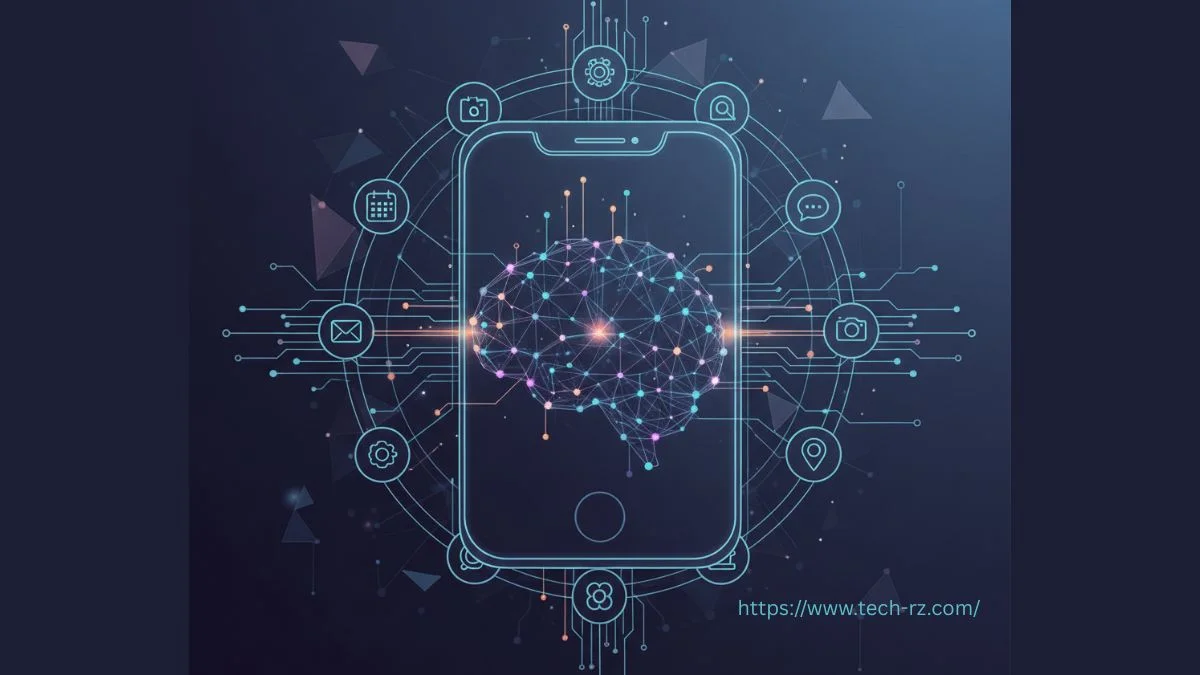
One of the major changes is how fast organization’s adopting Machine Learning (ML) models in daily applications - such as mobile apps, SaaS platforms, enterprise software, and IoT ecosystems.
Now, organizations want their digital products to be intelligent, predictive, and customized, and Machine Learning is the main vehicle that makes this possible.
We at RZ Technologies collaborate with startups, enterprises, and tech-driven companies to develop intelligent software products. The app development is getting more automated, dynamic, and data-driven due to progress in GPU computing, edge AI, cloud ML platforms, and pre-trained models. The incorporation of ML in apps is not a “premium feature” anymore in 2026 — it is turning out to be a competitive necessity.
Integration of Machine Learning was not so simple. ML models were large, slow to train, and needed highly skilled ML engineers a few years ago. Deployment was even more difficult - models hosting, speeding up, performance monitoring, and data protection were complex and costly.
The situation has changed in 2026.
Four breakthroughs have made it possible for ML integration to be considered a viable option for the majority:
Google, Meta, OpenAI, and Hugging Face, to name a few, provide:
These have cut down the development time by a great deal.
The present-day mobile phones, wearables, and IoT gadgets are capable of running ML models locally with the help of:
This is making applications quicker, more secure, and private.
AutoML allows non-experts to train machine learning models easily using drag-and-drop interfaces
With the help of automated:
These allow ML integration to be stable, reliable, and manageable for big corporations.
Moreover, ML integration is now very fast, cheap, and scalable due to all the innovations, which makes 2026 the most AI-friendly year for application development so far.
ML adoption is a key to success for businesses in any industry, including healthcare, fintech, e-commerce, logistics, real estate, and education. The time of apps with only static and elementary features is gone. Users demand:
Some of the most significant business benefits of Machine Learning integration are:
ML-powered customization makes customers happier, and loyalty gets higher.
ML algorithms sift through large datasets quickly, and thus, instant predictions and suggestions can be made.
Automation takes over human work in:
Intelligent features can be the source of premium subscriptions, AI add-ons, and enterprise AI packages.
The ones that provide AI-powered services will be the winners against traditional apps.
Integrating ML with applications requires various contemporary techniques. RZ technologies employ modern tools and patterns of engineering to make sure the models are precise, quick, and of a quality level that can be used by an enterprise.
Directly utilizing models on the gadget for:
Advantages
Apps that require large ML models or intensive calculations.
Standard cloud AI providers:
Employments
When a company needs to have a unique solution, RZ Technologies creates and deploys a custom ML model with:
Such models are available from:
We set up pipelines to guarantee:
This is a way to ensure that ML models keep being correct in the long run.
Machine Learning is changing the core of software. Below are the most trending use cases businesses demand in 2026.
Used in:
The ML models make the predictions of what the user will most likely want and thus recommend it automatically.
Assists businesses in predicting:
Predictive models become indispensable in data-driven industries.
Chatbots powered by NLP models:
In 2026, chatbots will be as good as human assistants in terms of behavior.
ML is being used by banks, fintech apps, and online businesses for the detection of:
Examples of use:
An app library contains functions such as:
Nothing is left out from app design to content flow, which turns adaptive and user-specific.
RPA + ML automate:
Search within the app becomes smart:
ML models interpret:
Afterward, they offer tailored advice.
Here's the way ML models from RZ Technologies
We look over:
In a given scenario, a decision could be to use:
The models are getting the training with:
Choices:
We link the model with:
Comprises:
The company keeps a track of:
Mobile phones today have enough processing power to do:
Applications continuously adjust their behavior to that of the user.
Example: Two users get different dashboards reflecting their interaction patterns.
The training of the models is done locally on the device without the data being sent to the cloud.
The non-expert teams in the field of ML can train basic models on their own.
Handling data on the fly (streaming inference).
With just a few small changes, ML customization becomes faster and more inexpensive.
Task-driven agents that can handle:
Smart factories, farms, homes, and logistics systems are empowered with ML insights that are put into action immediately.
Along with data cleanup, RZ Technologies also offers preprocessing and validation pipelines.
To solve this problem, we put in place continuous model training, scheduled updates, and performance monitoring.
On our side, the methods that are implemented to solve this problem are:
Some of the most commonly employed security tactics we use are:
Our MLOps is capable of:
We are fully in charge of everything from data pipelines to UI integration.
We decide on the best method to use, considering the factors of cost, speed, and accuracy.
We have worked with the following sectors: fintech, real estate, retail, healthcare, logistics, education, and many more.
The projects we accomplish have the ability to scale up to millions of users.
Clients get:
We take care, update, and make your ML models better constantly.
Machine Learning integration into applications is no longer a fantasy coming true in the distant future — it represents the essence of software development in 2026. ML-driven apps are the most effective way of doing business across the board, as they can be used for any purpose from empowering user experience to intelligent automation of business processes while predicting trends.
By making AI more accessible and powerful, companies are forced to evolve their digital solutions if they want to stay competitive. The question is not whether to integrate AI but when and how RZ Technologies is the answer — delivering future-ready applications with Cloud, MLOps, Machine Learning, and intelligent automation.
In case your business would like to machine learn your way through the next generation of apps — be it mobile, web, SaaS, or enterprise systems — RZ Technologies is the partner that will get you there.
Machine Learning model integration is the process of embedding ML algorithms in software, which then gains the ability to be intelligent, predictive, and to perform automated decision-making.
At the end of 2026, the demand for apps is that they would be more personalized, quicker, and automated. Incorporating machine learning technology into a business will not only benefit customer satisfaction but also increase profit by reducing costs of operations and maintaining a competitive edge in the market.
Absolutely. The advent of pre-trained models and cloud AI services has made ML implementation both a quick and affordable process, even for small businesses.
For instance, healthcare, fintech, retail, logistics, education, and real estate are the industries that benefit most from the deployment of ML-powered apps and have already taken the lead in adopting them.
The team at RZ Technologies is involved in all stages of the process — they prepare the data, develop the custom model, deploy it, optimize it, and monitor it continuously.